Upload / Capture
Race day has a way of making every runner feel like a beginner again.
You can follow the training plan, test the shoes, practice the gels, lay out the kit, check the weather 15 times, get to the start line early, tell yourself not to go out too fast...And then the race starts.
The crowd surges. The watch beeps. The first mile feels too easy. The weather changes. The stomach gets weird. The shoes that felt perfect in training suddenly feel different. The goal pace that seemed reasonable on paper starts negotiating with your legs.
That tension between the plan runners build and the decisions they actually make once the race starts is what Race Day Insights is about.

WeeViews partnered with Elizabeth Clor--marathoner, blogger, and author of Boston Bound--to survey 252 runners about how they prepare, what they trust, what they fear, what they get wrong, and what they’ve learned from racing. The responses came from runners preparing for or reflecting on everything from 5Ks and half marathons to Boston, Chicago, Berlin, ultras, trail races, and local community events.
The survey covered the obvious race-day topics: shoes, fueling, pacing, gear, recovery. But the more interesting story came through in the patterns underneath.
Runners are serious planners. They choose shoes weeks ahead, build fueling plans, set pacing goals. They rely heavily on personal experience. Many feel confident going into race day, but they also adapt constantly. They adjust fueling when their stomach turns, shift pacing based on feel, change expectations when the weather turns ugly. They learn, often the hard way, that the biggest race-day mistakes usually come from ignoring what the day is telling them.
That is the central story of Race Day Insights 2026: runners plan ahead, but race day rewards flexibility.
Related: Race Day Insights Podcast Episode with Elizabeth Clor
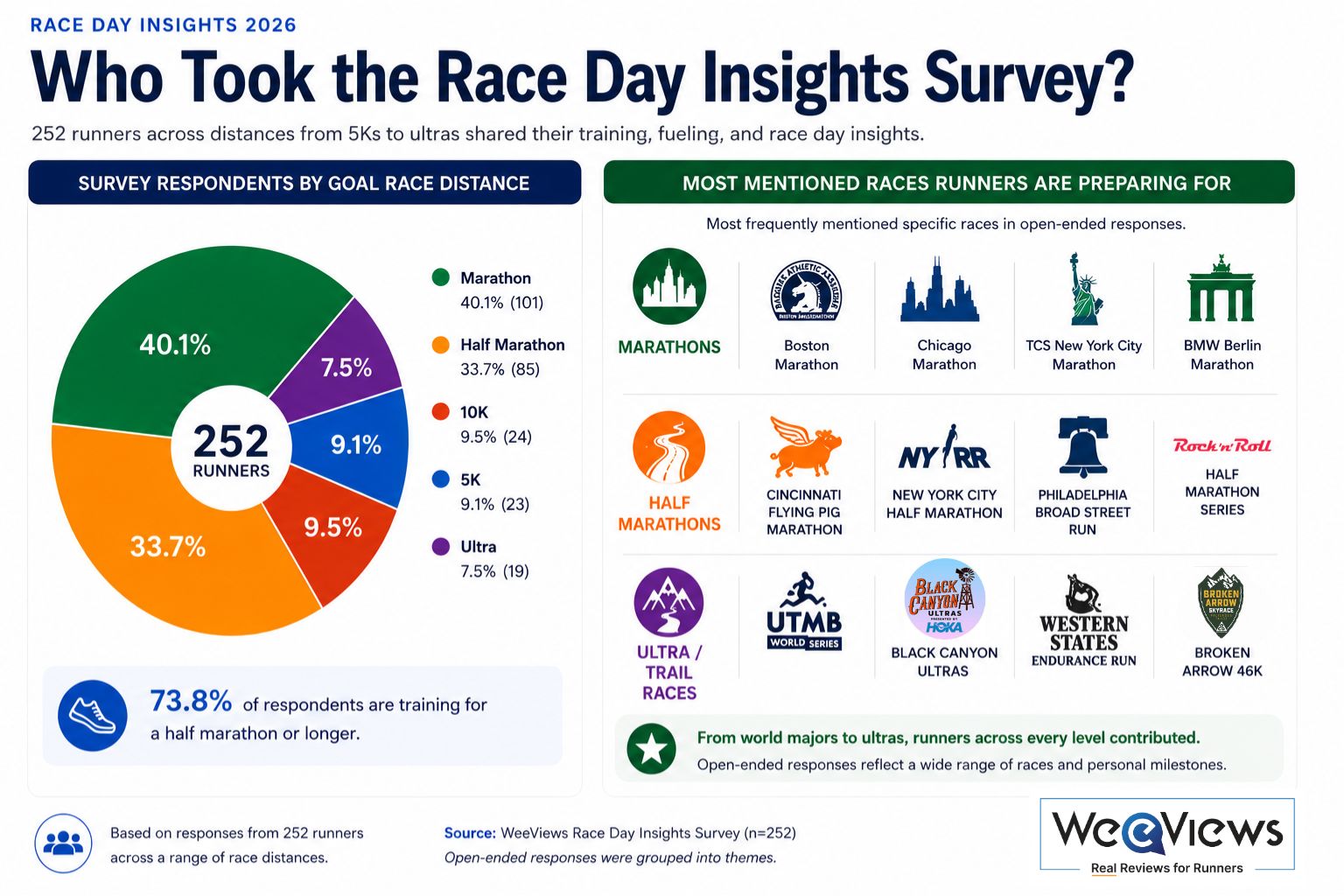
Before getting into shoes, fuel, pacing, and race-day mistakes, it helps to understand who responded.
This was not a beginner-heavy survey. Most respondents described themselves as serious recreational runners, with a strong concentration around marathon and half marathon distances.
Race-day behavior changes with distance. A 5K runner thinking about shoes, pacing, and warmup is making very different decisions than a marathoner trying to manage glycogen, weather, pacing discipline, and fatigue over 26.2 miles. An ultra runner brings an entirely different relationship with effort, terrain, fueling, and problem-solving.
So rather than treating “runners” as one generic group, the survey gives us a layered look at how different kinds of runners think about race day.
Some findings were expected:
Other findings were more revealing:
Few race-day decisions get runners talking like shoes.
For years, carbon-plated shoes were treated like elite racing tools: fast, expensive, and slightly mysterious. Now, they have moved deep into the recreational field, especially at the marathon distance.
In our survey, 63.4% of marathon runners said they planned to race in carbon-plated shoes, signaling mainstream adoption among marathoners.
Related: 18 Carbon-Plated Shoe Picks
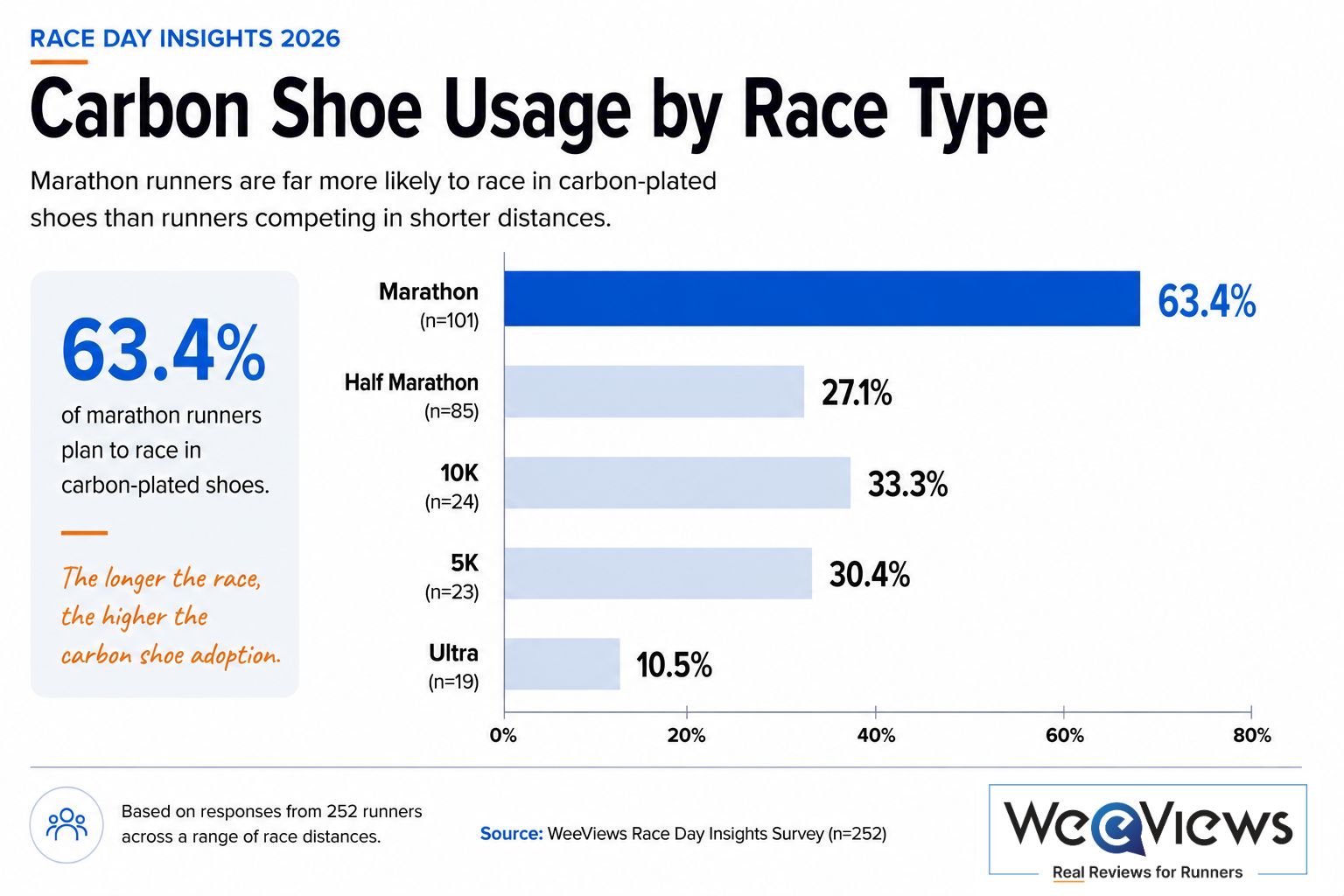
The race-distance breakdown tells a clear story. Carbon adoption was highest among marathoners and lowest among ultra runners--likely a testament to terrain. Shorter-distance runners landed somewhere in the middle, while half marathoners were notably less carbon-heavy than marathoners.
That makes sense.
The marathon is where carbon shoes promise the biggest perceived payoff: efficiency, late-race leg preservation, and the feeling that every advantage matters. Over 26.2 miles, small gains feel bigger. The shoes are not just about speed; for many runners, they are about confidence.
But the data also makes something clear: carbon shoes are not replacing everything. Comfort, familiarity, and distance still matter. Not every runner views race day through the same performance lens. The adoption curve for carbon-plated running shoes gets even more interesting when we look at training volume.
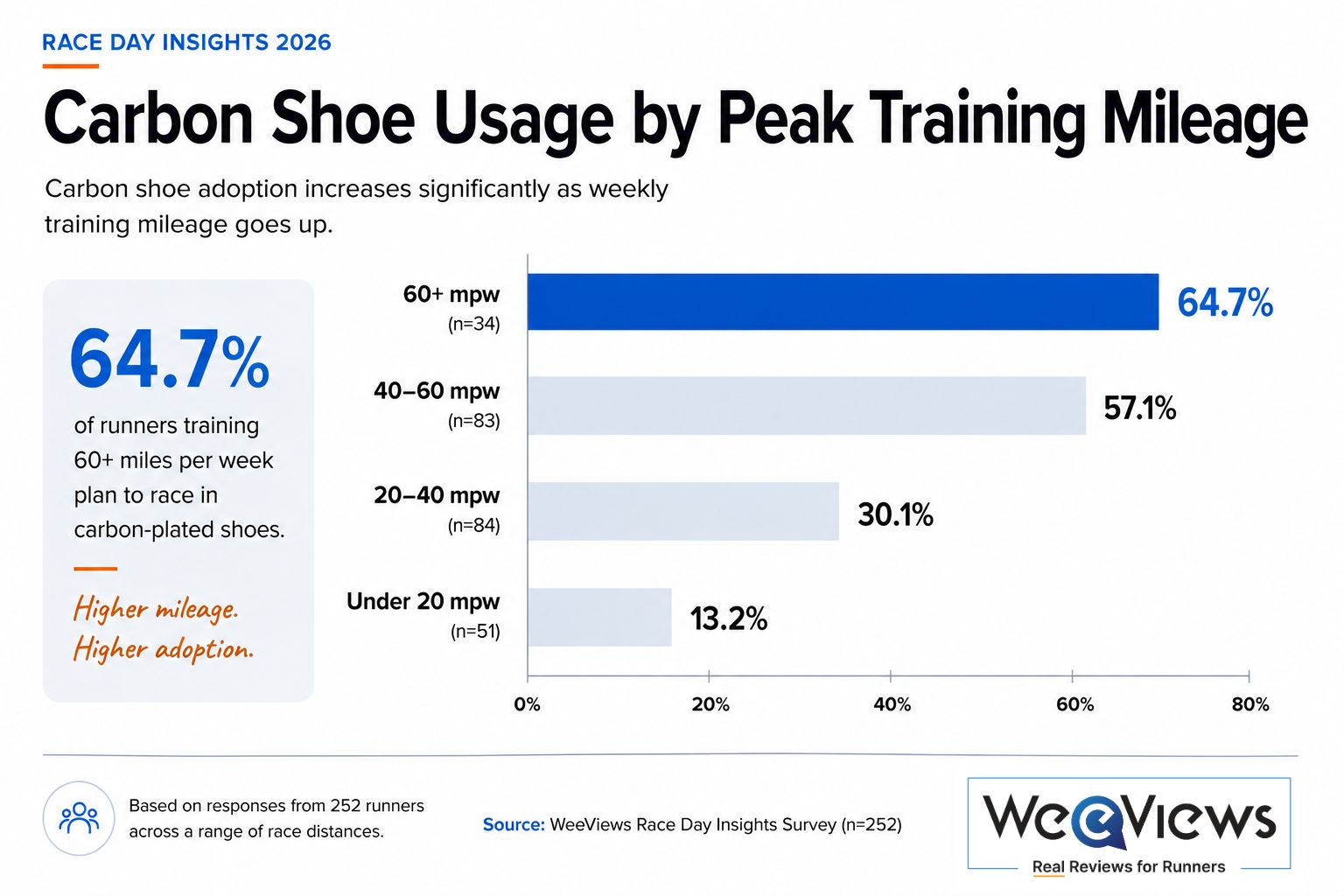
Carbon shoe usage rose sharply among runners training higher weekly mileage. The inflection point appears around 40 miles per week, with runners above that threshold much more likely to choose carbon-plated shoes for race day.
That is an important behavioral insight.
Carbon adoption is not just about race distance. It is also about how seriously runners are training. Higher-mileage runners are more likely to be chasing time goals, more likely to have tested race-day shoes in workouts, and more likely to treat shoes as part of a broader performance system.
In other words, carbon shoes are not just gear. They are a signal of intent.
The race-day shoe landscape was not dominated by one brand.
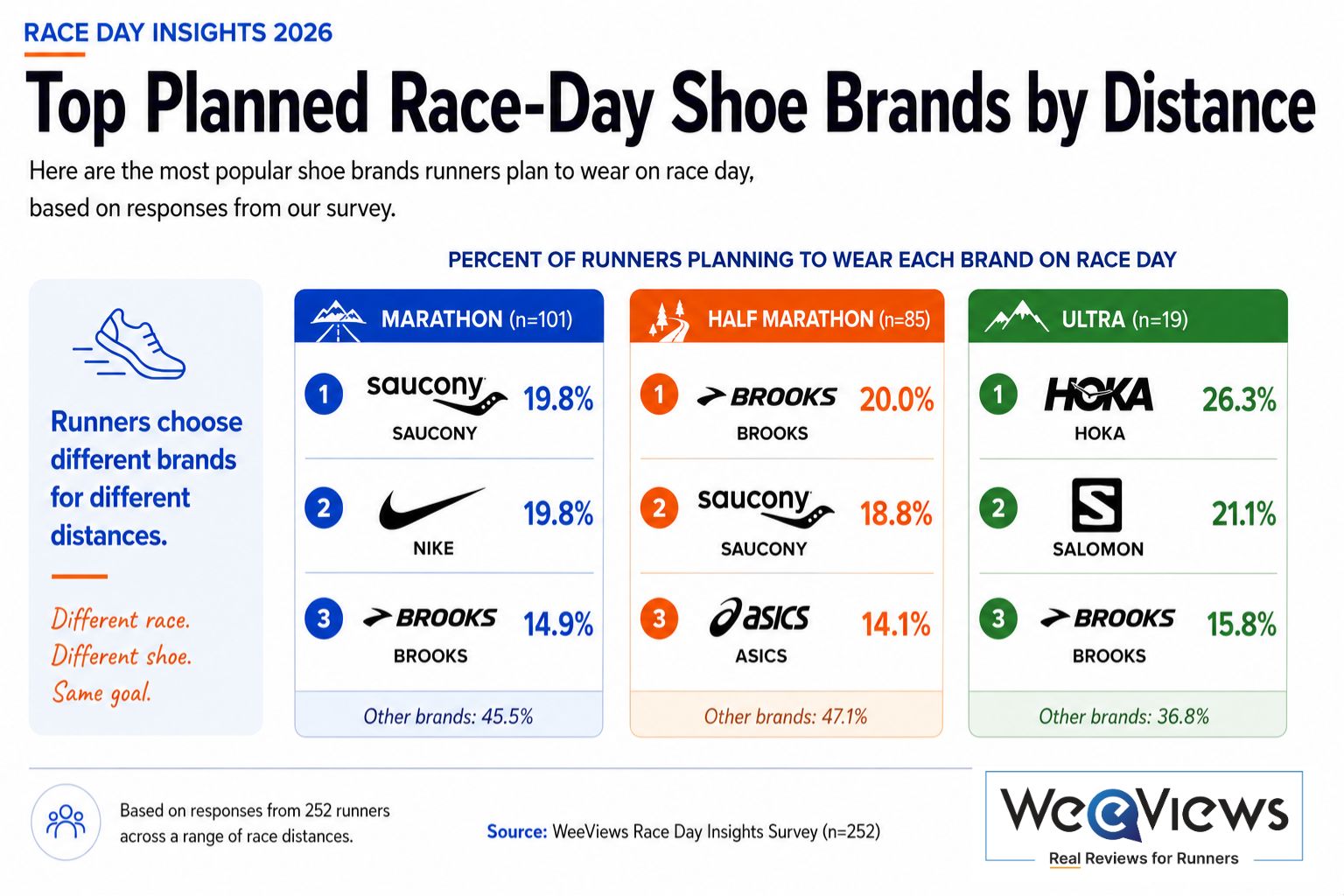
This is where the survey becomes especially useful. It does not just show which brands runners like, it also shows how brand choice changes with race context.
Runners do not choose shoes in a vacuum. They choose shoes for a specific job. Marathoners may be thinking about efficiency and performance while half marathoners may be balancing comfort and speed. Ultra runners may prioritize protection, stability, traction, fit, and long-term comfort over plated efficiency.
The carbon-by-brand data adds another layer.
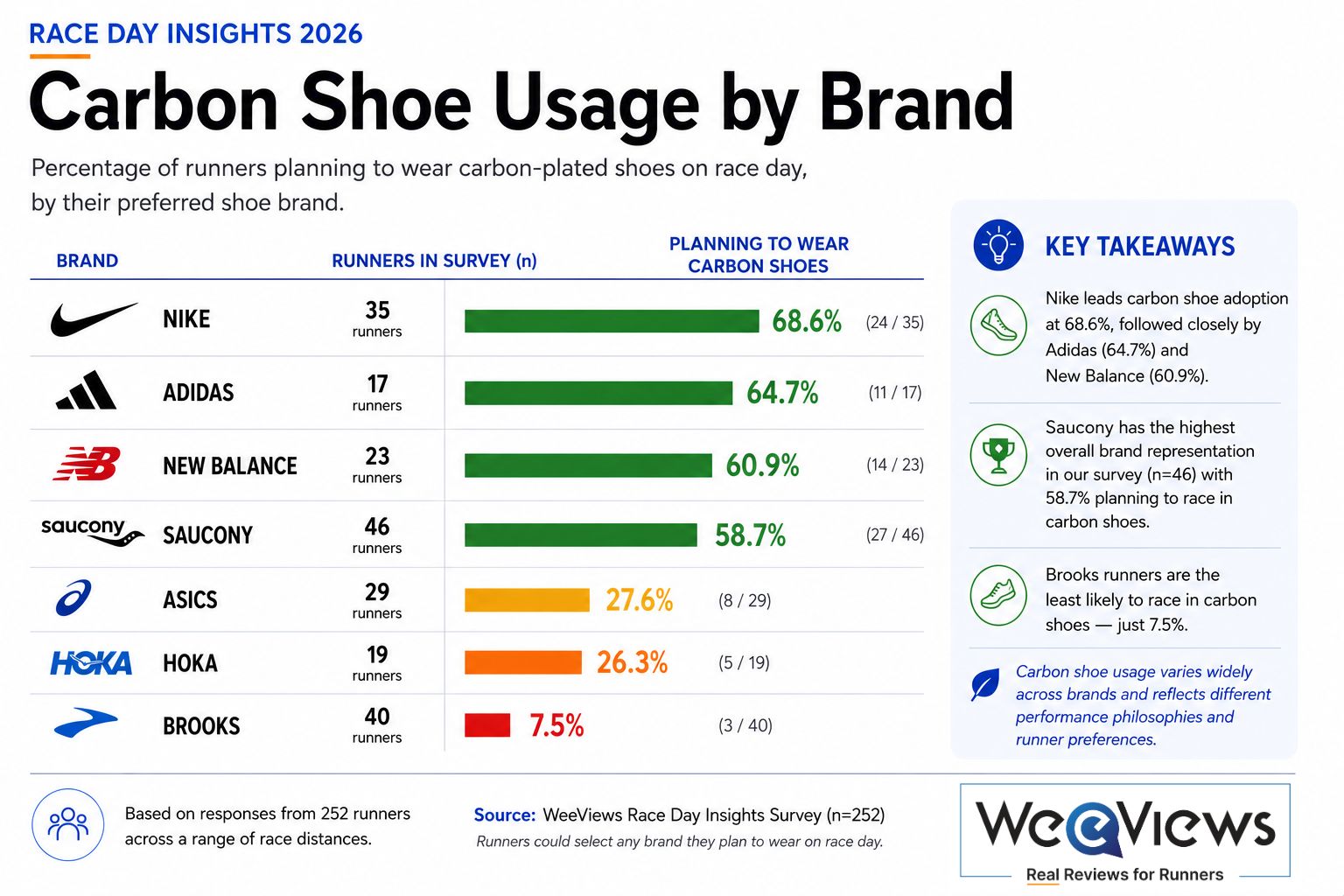
Nike, Adidas, New Balance, and Saucony had the highest carbon usage rates among runners planning to race in those brands. Brooks was the opposite story: a strong race-day brand overall, but with very low carbon usage among its surveyed runners.
This suggests that some brands are functioning as carbon-performance ecosystems, while others are showing up more as trusted comfort, familiarity, or daily-training-to-race-day brands.
For runners, that may be the real takeaway: the “best” race-day shoe is not just the fastest shoe on paper. It is the shoe that matches the runner’s race, goal, training, and risk tolerance.
See how those findings shaped our guide to the best marathon racing shoes.
If shoes are the most visible race-day decision, fueling may be the most consequential.
A bad shoe choice can make a race uncomfortable. A bad fueling strategy can end it.
The survey showed that runners take fueling seriously. Gels dominated race-day fuel choices, followed by drink mix, chews, whole foods, and candy or sweets. Among marathoners, gels were nearly universal.
Related: 9 Running Gels to Boost Performance
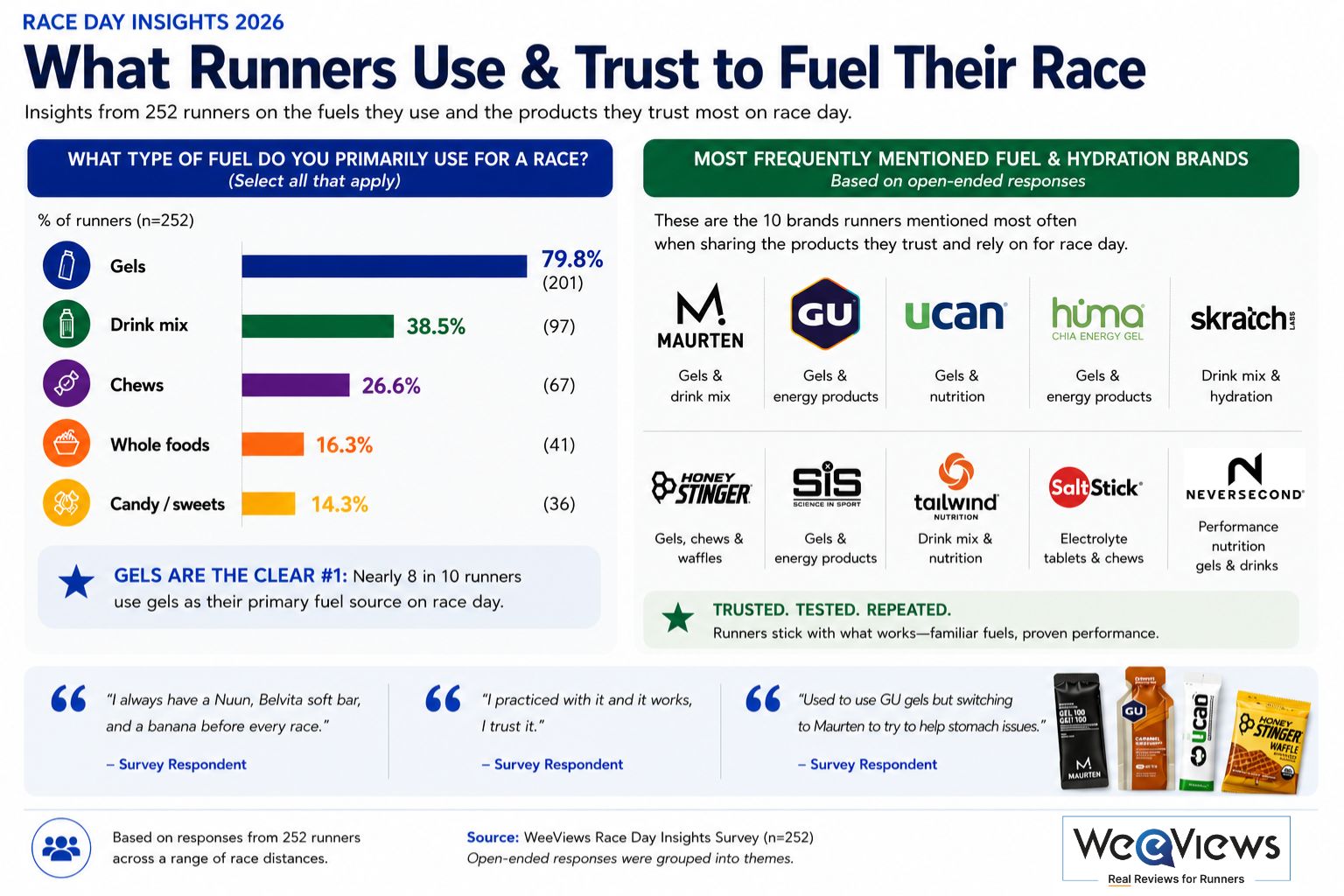
But the more interesting data point was not what runners planned to use. It was how closely they actually followed the plan.
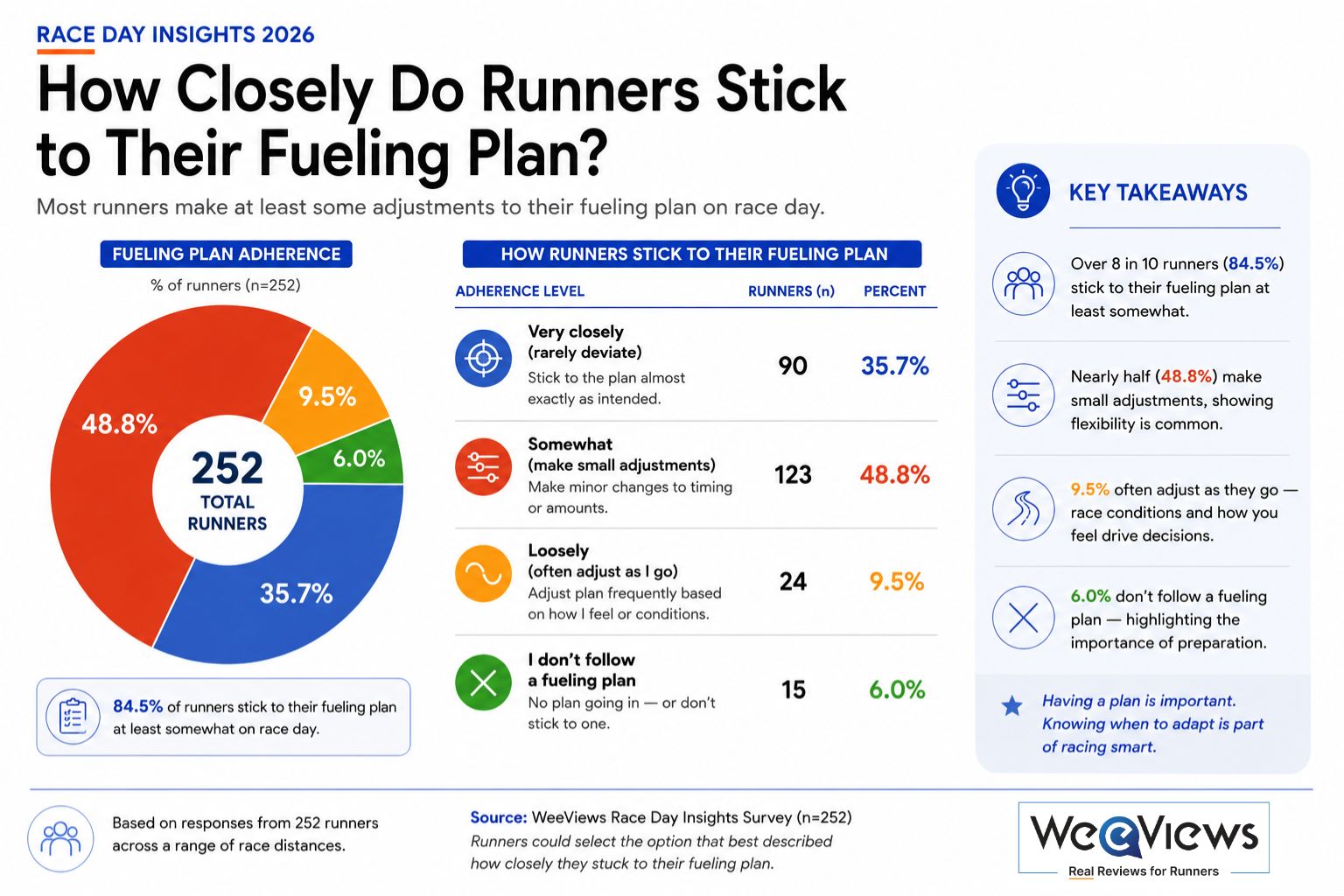
Only 35.7% said they follow their fueling plan very closely and rarely deviate.
Nearly half (48.8%) said they follow it somewhat but make small adjustments.
Another 9.5% said they follow it loosely and often adjust as they go, while 6.0% said they do not follow a fueling plan.
That is the race-day reality in one chart. Runners plan, then the body votes. Maybe the stomach turns, the weather is hotter than expected, the aid station comes too early or too late, the runner feels great early on and skips a gel, or the caffeine works in training and backfires on race day.
The open-ended responses reinforced the same theme: runners repeatedly mentioned under-fueling, fueling too late, missing gels, taking unfamiliar products, not practicing with race-day nutrition, and falling behind on hydration.
One runner put it succinctly:

That may be one of the most useful pieces of advice in the entire survey.
Fueling is not just about fixing a problem once it appears. By the time a runner feels depleted, the mistake may already be an hour old.
Race plans often sound precise. Maybe there's a goal pace, a split chart, scheduled watch alerts, or pace bands.
But when runners described how they actually plan their pacing, strict targets were the minority.
Only 14.7% said they use strict pace targets. A much larger group (50.4% ) said they use a general pace range. Another 32.1% said they pace by effort or feel, while 2.8% said they go in with no pacing plan.
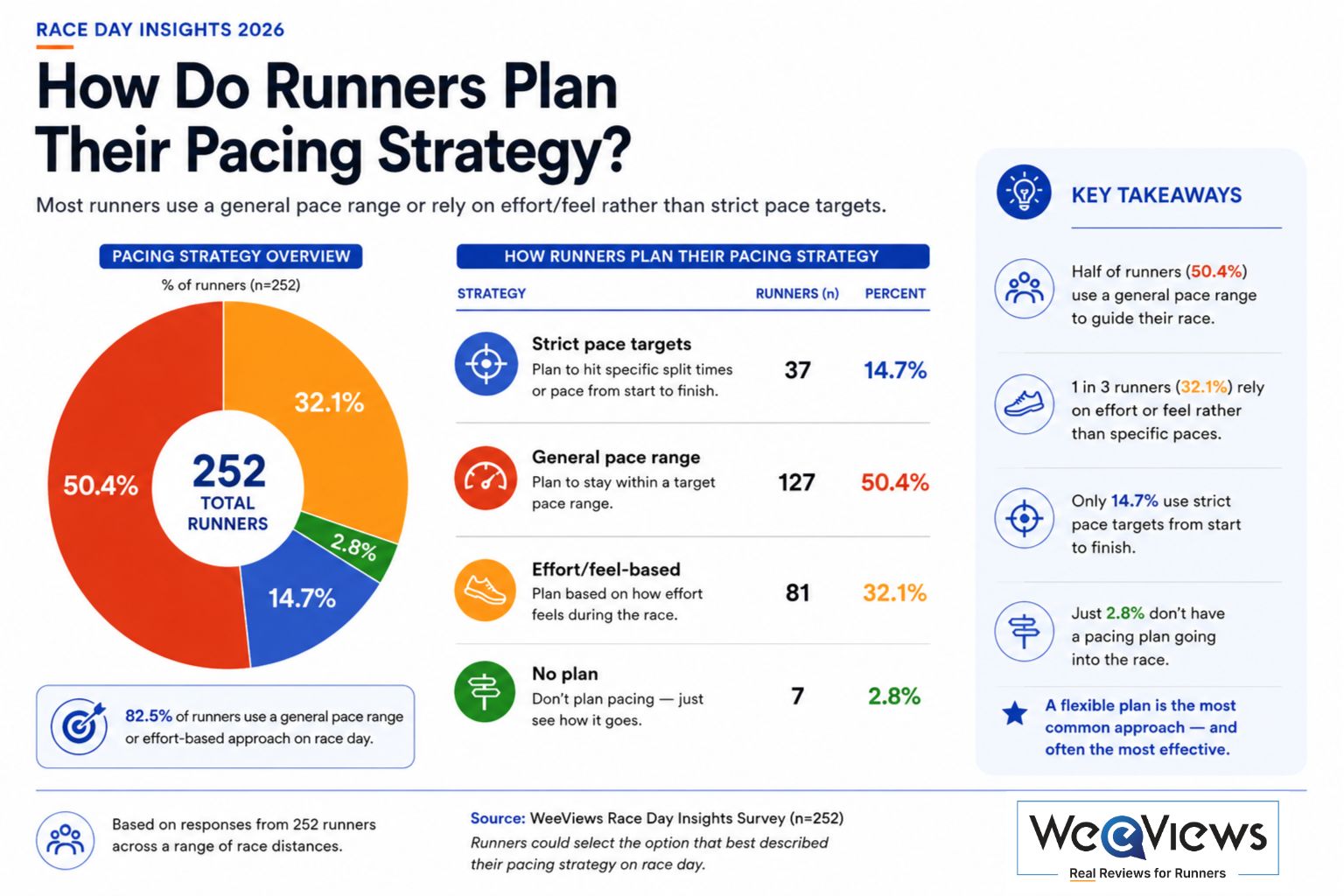
That finding supports one of the strongest themes of the whole survey: real race-day execution is more flexible than most advice makes it sound.
A strict pace target can be useful. It gives structure and prevents overreaction, helping runners avoid the early miles that feel “free” but rarely are. But a rigid pace target can also become a trap.
Weather, hills, crowding, stress, fueling, sleep, and course conditions all change what a pace actually costs. A 7:30 mile on a cool, flat day is not the same as a 7:30 mile into wind, heat, rolling hills, or a crowded start.
The best runners in the survey seemed to understand that pacing is not just a number. It is a negotiation between the plan and the body. That came through especially strongly in the race-day mistake responses.
Again and again, runners said some version of the same thing:
- “I went out too fast.”
- “There is no such thing as banking time in a marathon.”
- “Start slower than you think you should.”
The lesson is not that pace goals are bad, but rather that pace goals need room to breathe.
Race-day nerves are rarely random. They cluster around the things runners know can derail a race: pain, weather, bonking, nerves, pacing mistakes, and bathroom logistics.
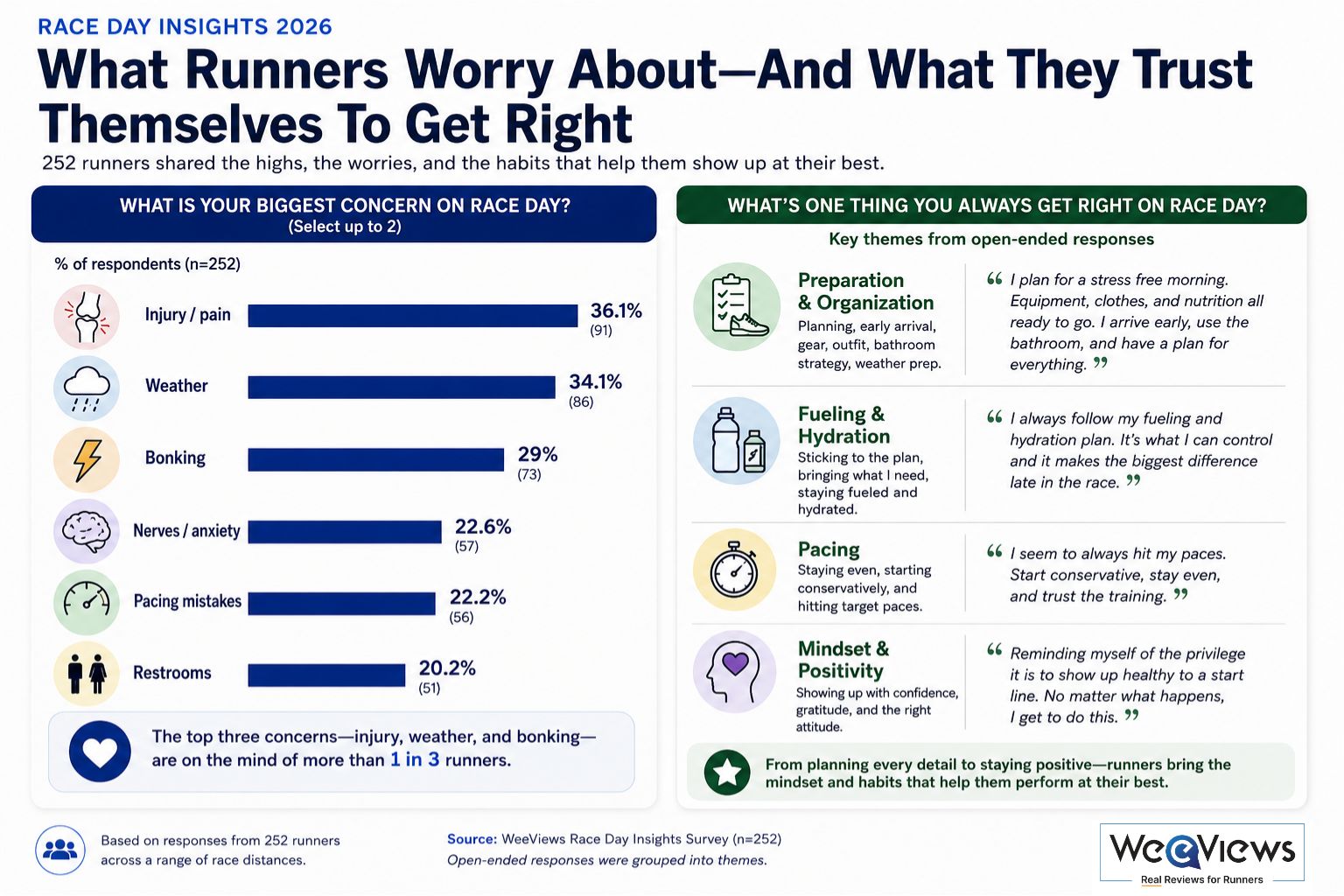
The top concern was injury or pain, cited by 36.1% of runners. Weather was close behind at 34.1%. Bonking came in at 29.0%. Nerves and anxiety, pacing mistakes, and bathroom logistics all landed in the 20% range.
This is where the survey felt especially human.
Runners worry about performance, but not only performance. They worry about the body cooperating, the environmental conditions, the bathroom lines, the moments when racing goes sideways.
But when asked what they usually get right on race day, the tone shifted.
The open-ended answers were full of routines, rituals, and quiet confidence:
When asked what they usually get right on race day, one runner wrote:

Race day is full of anxiety, but it is also full of competence. Runners may worry about the things they cannot control, but many have developed deep trust in the rituals they can control.
When runners were asked how confident they felt in executing their race-day plan, the results leaned positive.
Nearly 70% rated their confidence at either 4 or 5 out of 5.
That does not mean runners expect race day to be easy. It means most feel they have enough experience, planning, and self-awareness to handle what comes.
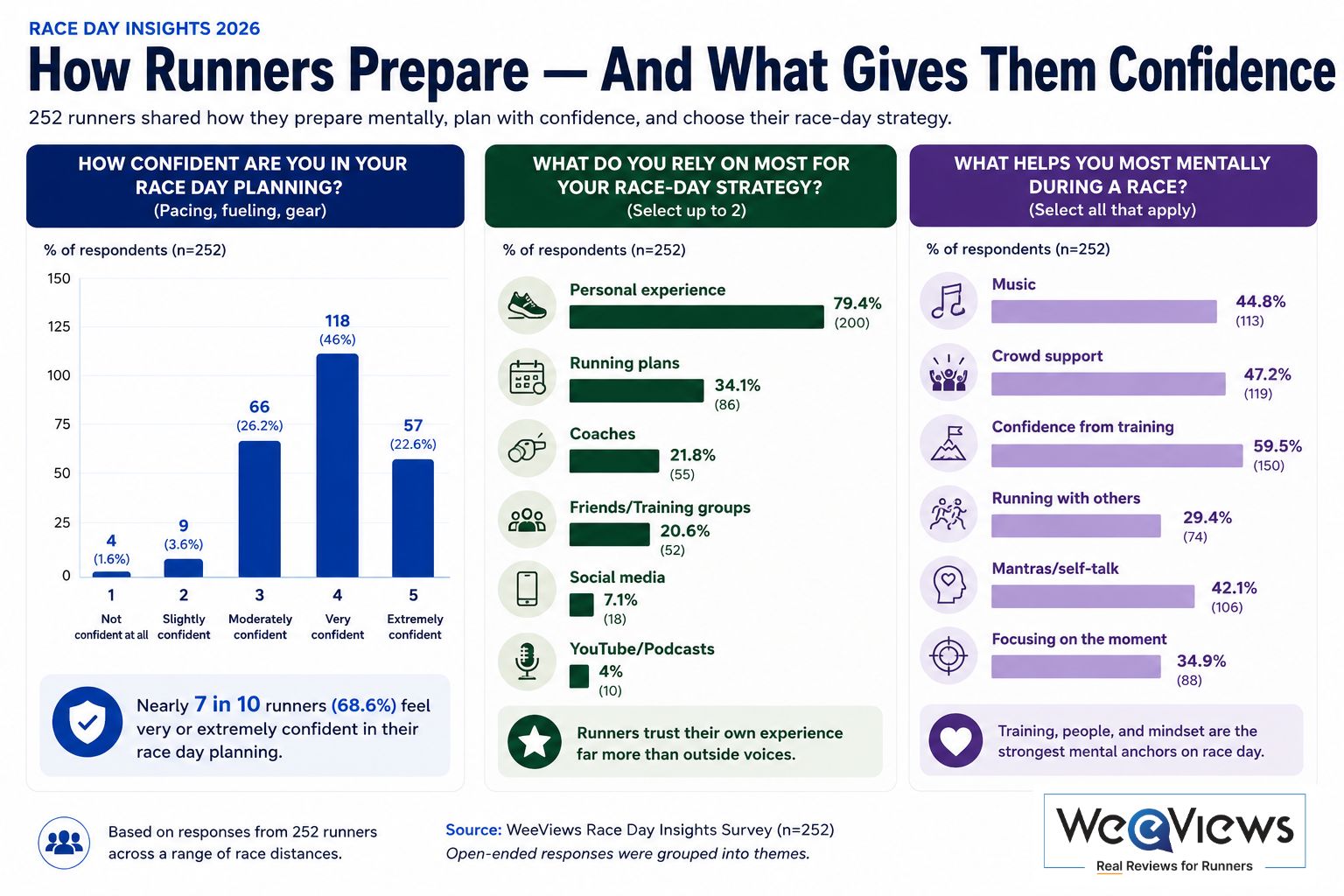
The most revealing part was what runners said they rely on for race-day strategy.
Personal experience dominated. Not influencers. Not podcasts. Not social media. Not even coaches.
That is one of the most important insights in the entire survey.
Race-day wisdom is earned through repetition. A runner learns how much time they need before the start, which shorts chafe, which gel sits well, how weather changes expectations, how to regroup when things go sideways.
The internet may offer advice, but race-day confidence often comes from lived proof.
That does not mean outside guidance has no value. Coaches, plans, running groups, podcasts, and social media all play a role, but the survey suggests runners ultimately trust what they have practiced and survived.
That is why so many responses returned to the same simple rule: nothing new on race day.

It is cliché in running because it keeps being true.
If this survey had one universal confession, it was this: Runners start too fast.
The wording changed, but the theme did not.
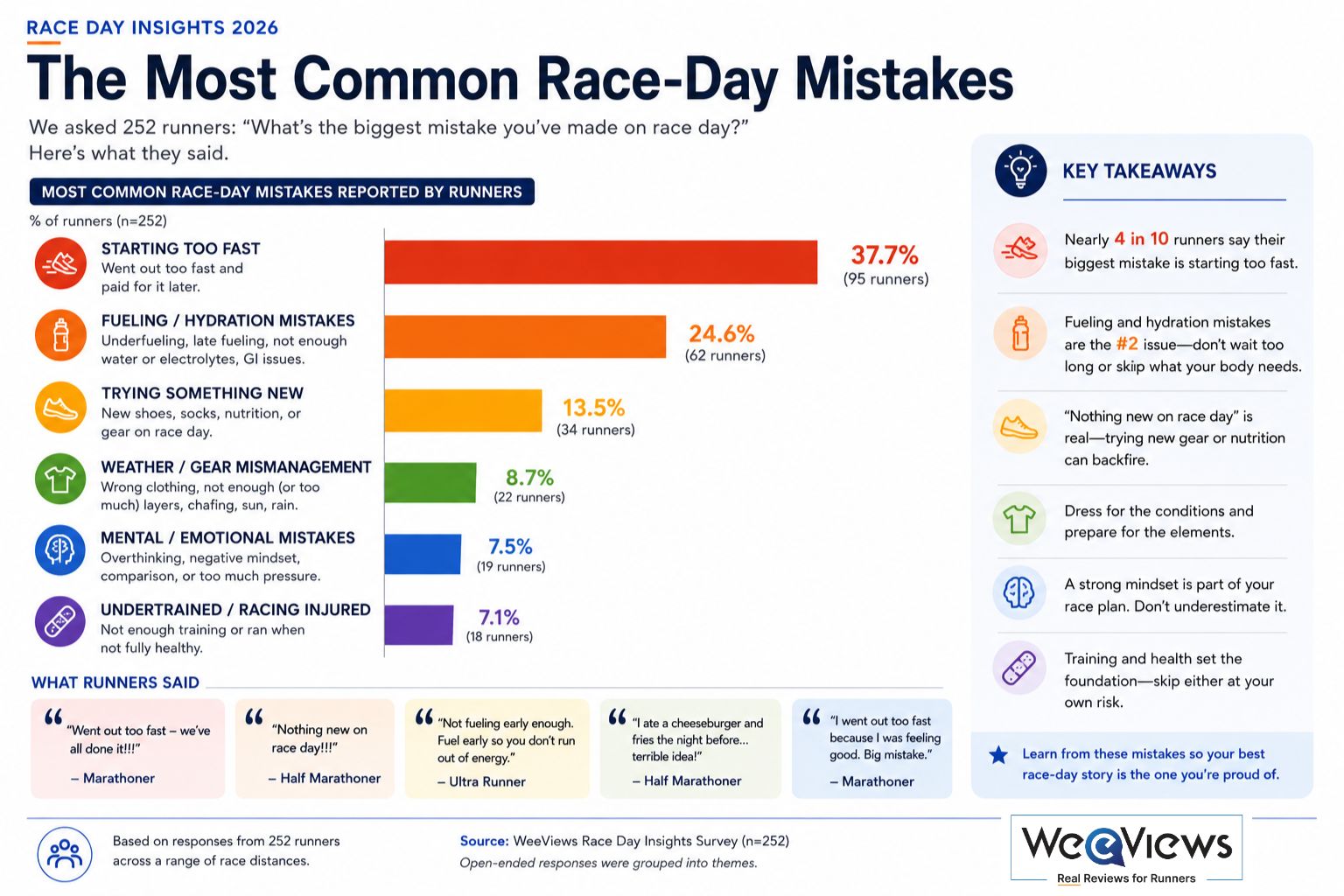
Starting too fast was the dominant open-ended mistake. Fueling and hydration mistakes were close behind, followed by trying something new on race day, gear/weather issues, undertraining or racing injured, bathroom/GI problems, and mental mistakes.
The starting-too-fast theme is not surprising, but the volume was striking. It cuts across distances and experience levels because it is built into the race-day environment. The taper works and the legs feel springy, the crowd is loud, the first mile feels effortless, the watch says you are ahead of pace, and the ego starts doing the math.
And then the race gets honest...
One runner summarized the marathon version perfectly:
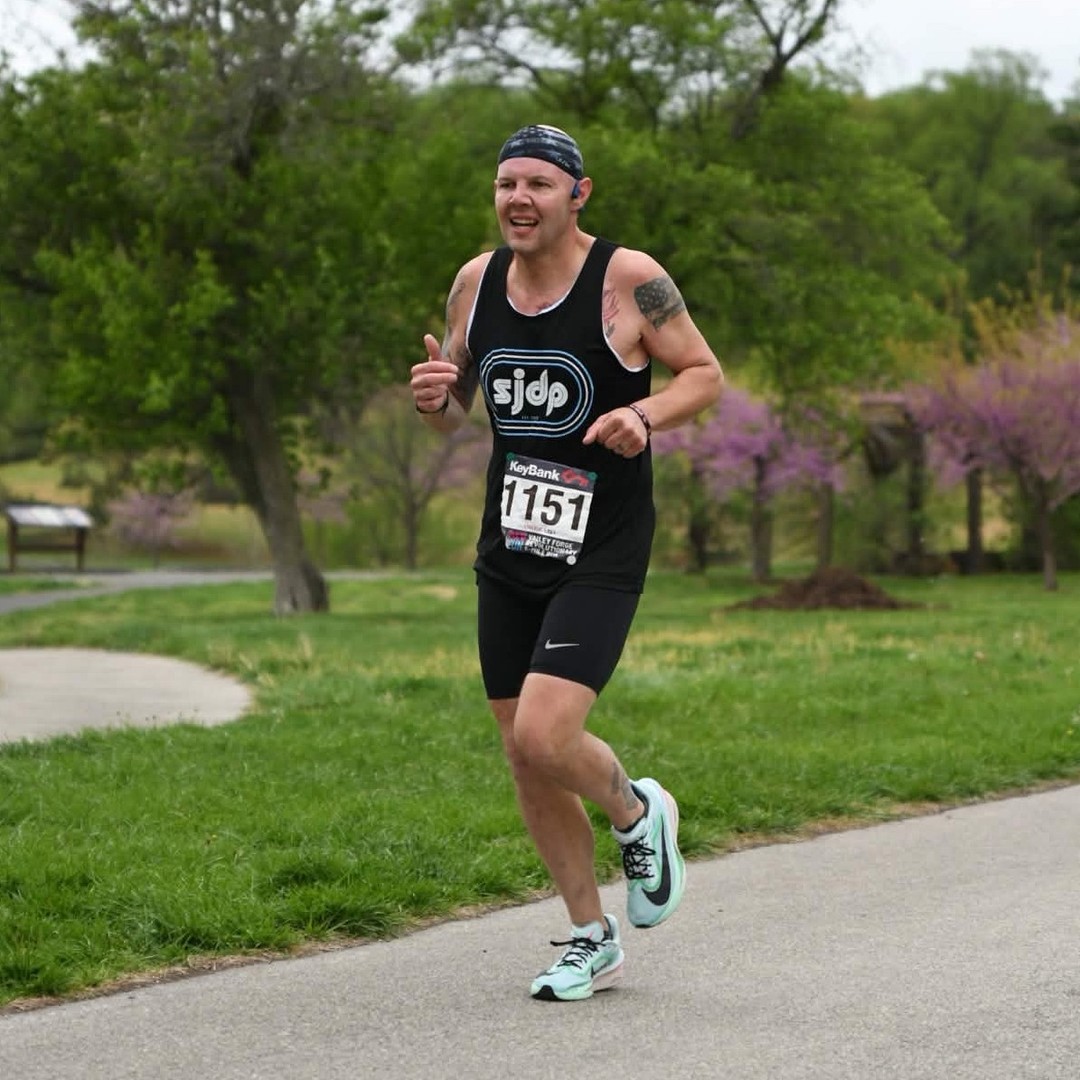
Another described a more painful lesson:

The best race-day advice in the survey was not complicated. It was repeated in different ways by runners who had already learned the hard way:
The lesson is simple.
Executing a race is not about proving fitness in the first mile. It is about still having access to that fitness when the race begins to ask harder questions.
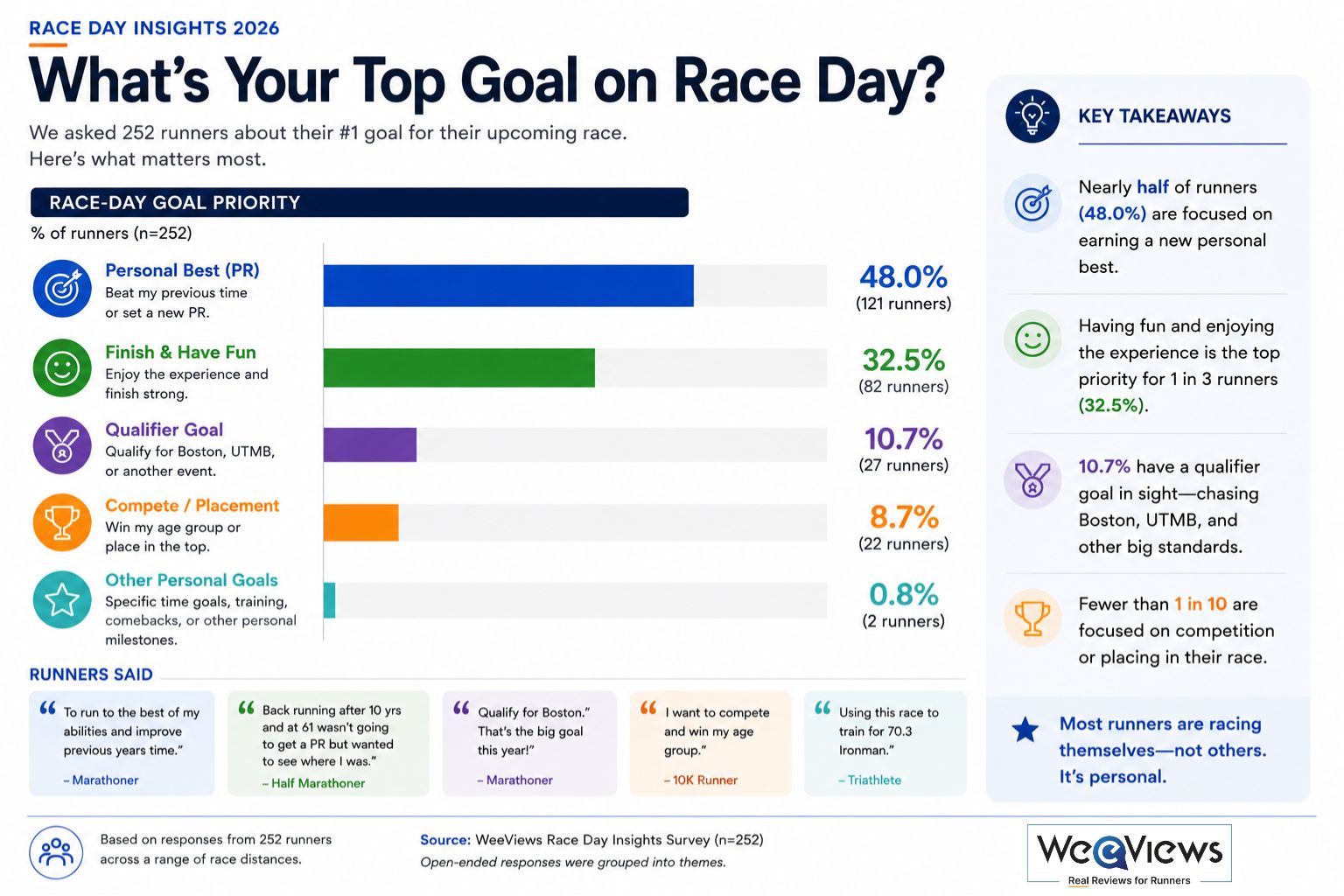
Personal best goals led the way, followed by runners who wanted to finish and have fun.
Qualifier goals formed a meaningful performance-driven subgroup, while competing or placing was a smaller share of responses.
That is an important reminder since running culture often celebrates the sharpest end of the race: podiums, qualifiers, PRs, rankings, and major marathon goals. And while those things matter to and motivate a lot of runners, the broader race-day motivation picture is more personal than competitive.
Some runners want to prove their training worked through a PR or a qualification, some want to finish strong and celebrate a return after injury or personal challenge, and some want to enjoy the day and be proud of finishing.
That range is what makes race day so compelling. Everyone stands on the same start line, but not everyone is chasing the same thing.
Race day does not end at the finish line.
For many runners, the first priority after a race is not a celebration photo or a beer. It is getting the body back online.
Post-race hydration was the top recovery priority, followed by nutrition, rest, and active recovery. Recovery gear was a very small share of responses.
Related: Recovery Drink: 7 Runner-Testing Picks to Bounce Back Faster
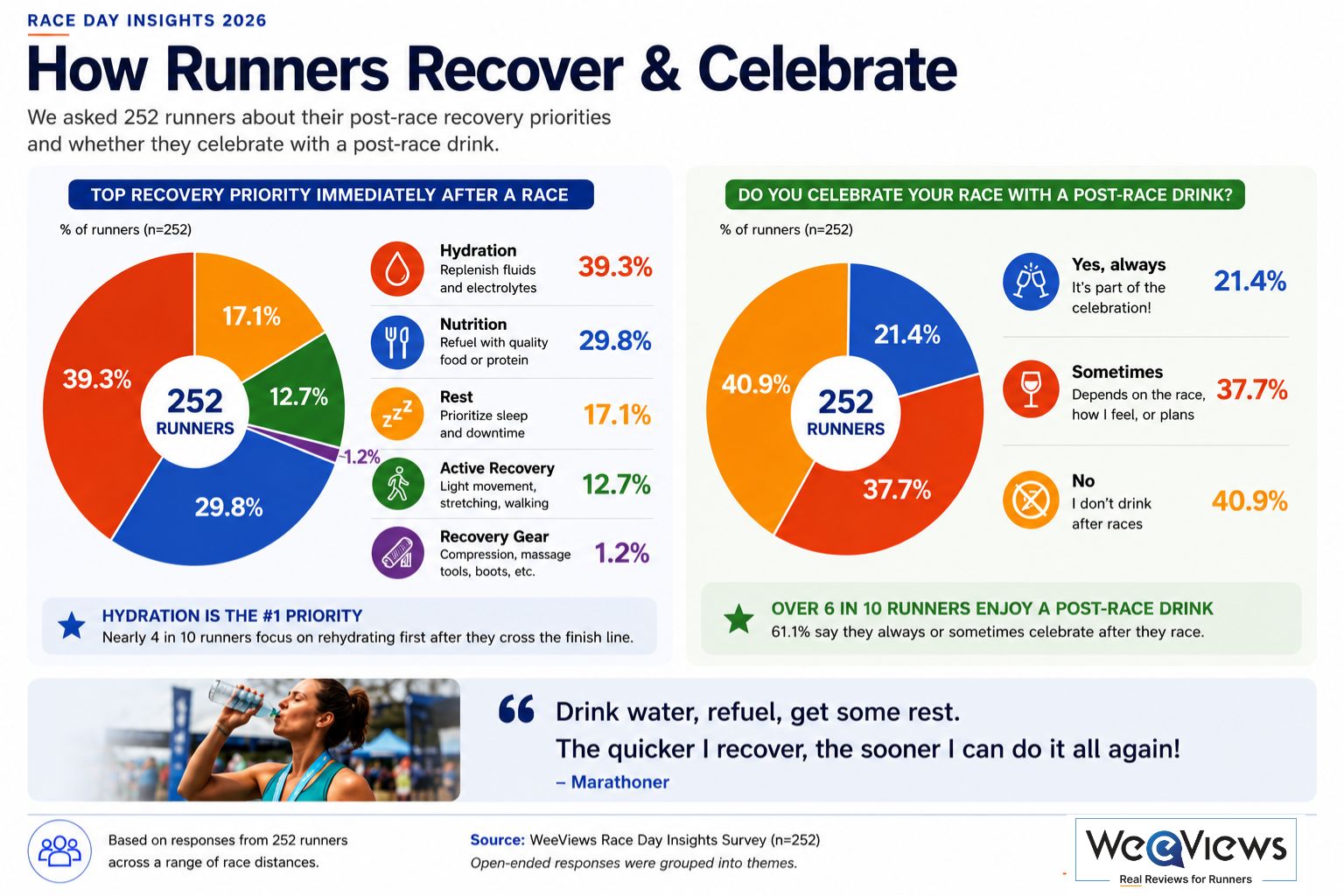
That is a useful corrective.
The recovery industry can make post-race recovery look complicated. But runners in this survey leaned toward the basics: drink, eat, rest, move a little, and let the body settle. If you want to dig even deeper into post-run recovery, check out our Running Recovery Insights where Dr. Bonnie Wilder gives expert insight on the best practices.
Celebration was more mixed. Some runners always celebrate with a post-race drink. Some do sometimes. Many do not. The post-race ritual is personal, just like the race-day plan itself.
That may be the broader recovery takeaway: There is no single correct finish-line ritual.
Some runners want beer. Some want water. Some want food. Some want quiet. Some want a nap. Some want to find their family. Some want to walk around in disbelief that it is over.
The common thread is not the specific ritual.
It is the need to mark the transition from a big effort back to ordinary life.
Related: 5 Recovery Shoes to Keep Your Feet Happy After Running
The most useful part of the survey may not be any single chart. It may be the collective wisdom that appeared across hundreds of open-ended responses.
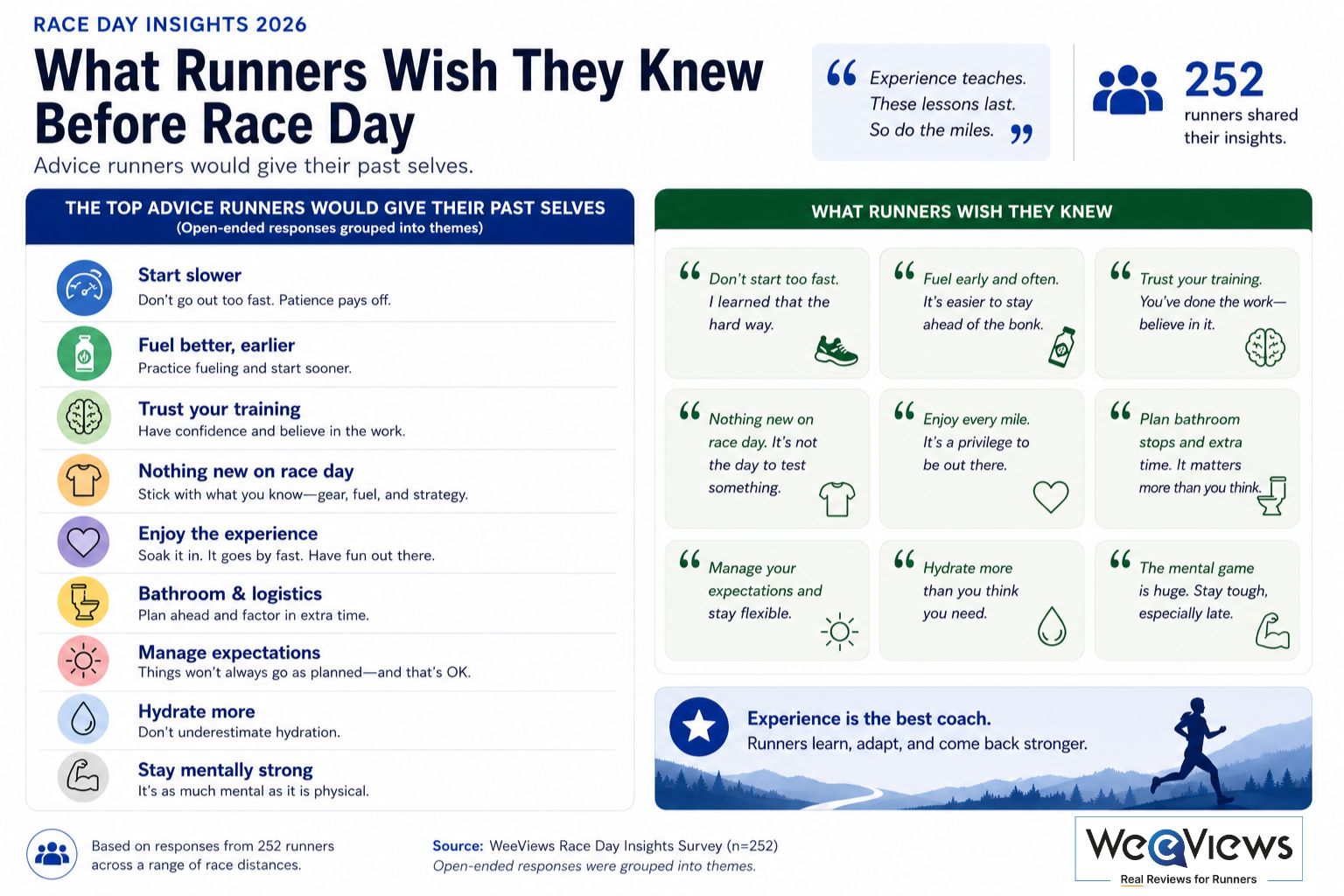
The advice was not flashy.
That is the funny thing about race-day wisdom. Most of it sounds obvious after the fact, but it rarely feels obvious in the moment.
Race day compresses emotion, preparation, uncertainty, and ego into a few hours. Runners do not just execute a plan. They manage themselves.
That is why personal experience carried so much weight in the survey. Every runner eventually builds a private race-day manual out of things that worked, things that failed, and things they swear they will never do again.
A pair of socks. A missed gel. A bathroom line. A hot first mile. A bad dinner. A weather mistake. A race that went wrong. A race that went better than expected.
That is how race-day confidence is built. Not perfectly--personally.
The strongest conclusion from Race Day Insights 2026 is not that runners should all follow one perfect race-day formula; in fact, the data says the opposite.
Runners are thoughtful. They plan their shoes, fueling, pacing, gear, logistics, and recovery. They test products, build routines, develop confidence from training and experience, but race day still demands adjustment. The best plans are not rigid.
That is what showed up across the survey:
Race day is where training becomes decision-making. And the runners who handle it best may not be the ones with the most complicated plan. They may be the ones who know their plan well enough to adapt when the race starts changing it.
The Race Day Insights 2026 survey collected responses from 252 runners about race-day preparation, execution, gear, fueling, pacing, mindset, mistakes, goals, and recovery. Respondents included runners preparing for or reflecting on races ranging from 5Ks and 10Ks to half marathons, marathons, and ultras.
Survey responses included a mix of multiple-choice questions and open-ended prompts. Percentages are based on survey response totals for each question. Open-ended themes were reviewed and grouped editorially to identify recurring patterns such as starting too fast, fueling mistakes, trying something new on race day, preparation routines, and mindset strategies.
Race Day Insights is a WeeViews editorial project designed to explore real runner behavior through community-driven survey data, expert commentary, and participant stories.
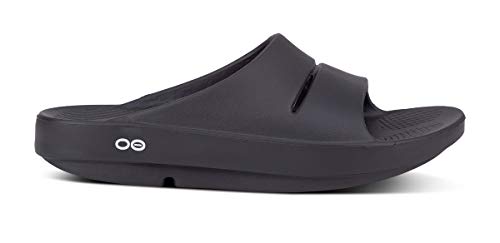
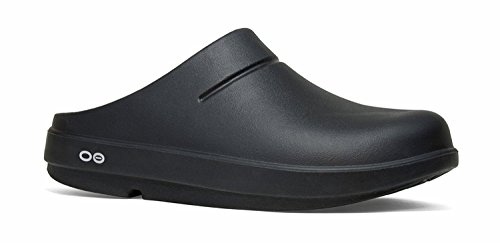
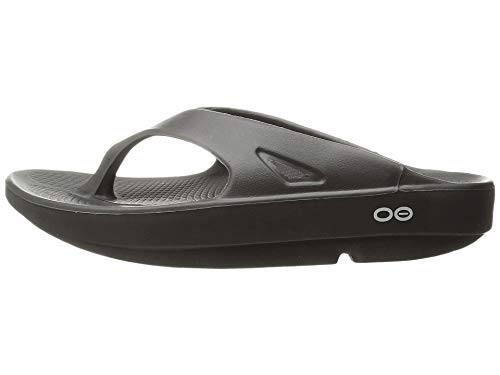
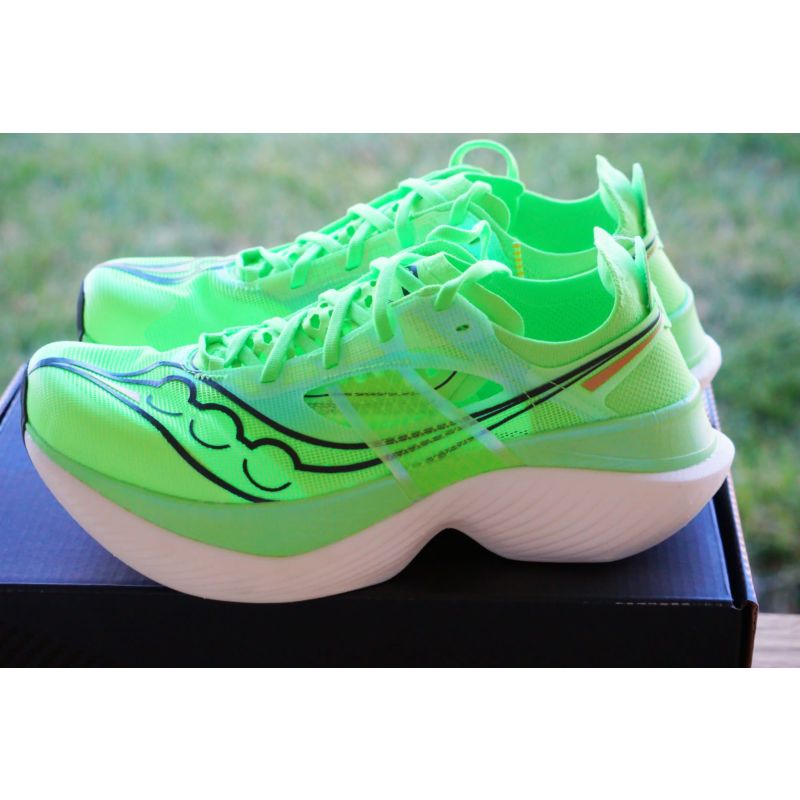
As part of the Race Day Insights survey, participants were entered to win giveaways from Swift Running, OOFOS, Fuel Goods, and Saucony, including running shoes, recovery footwear, and Fuel Goods gift cards. Participants were not aware of specific partner brands or prizes until after completion of the survey.


Login to your account to leave a comment.


Review gear you already use. Earn Star Points. Qualify to test free running shoes and gear.