Upload / Capture
Some lessons in ultrarunning are learned at the finish line. Others are learned when you decide to stop.
If there is one thing I have learned during my relatively short time running mountain ultras, it is this: when your body starts to struggle, a strong mind can still give you a chance of reaching the finish line. But when your mind gives up and you cannot turn things around, even the best-prepared runner can find themselves unable to continue.
When we watch videos of iconic international races, we are amazed by the incredible landscapes around the world. Yet sometimes we overlook the beauty that is much closer to home, or simply don't know what we are missing.
Before discovering the Valle de Tena, I had heard about its mountains, but I had no idea just how spectacular they were. Now I can tell you that the scenery is absolutely incredible.
A race with its own identity
The Trail Valle de Tena has a special character. It is not part of the UTMB Index race circuit or the ITRA ranking system, which is unusual in today's trail-running landscape. To me, it is a reminder that there is more than one way to build a successful race.
The event offers several distances: 11 km, 20 km, 42 km and 80 km. All of them pack in a substantial amount of elevation gain, making this one of the most demanding race routes I have encountered in Spain.
There are also children's races and other activities throughout the weekend. Combined with the beauty of the surrounding mountains, this makes it a fantastic destination for a family trip, even for those who aren't running.
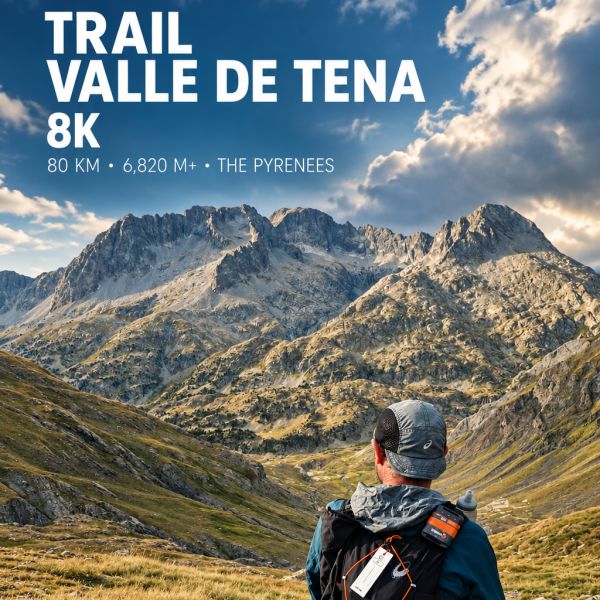
As has become something of a habit for us, we chose the longest distance: the 8K. The name doesn't sound particularly intimidating until you discover what it actually means: 80 km, 6,820 metres of elevation gain, and a similar amount of descending. That's when a cold sweat starts to form!
The race hub is Panticosa, a beautiful mountain village that serves as the finish venue for all distances and the starting point for the 8K.
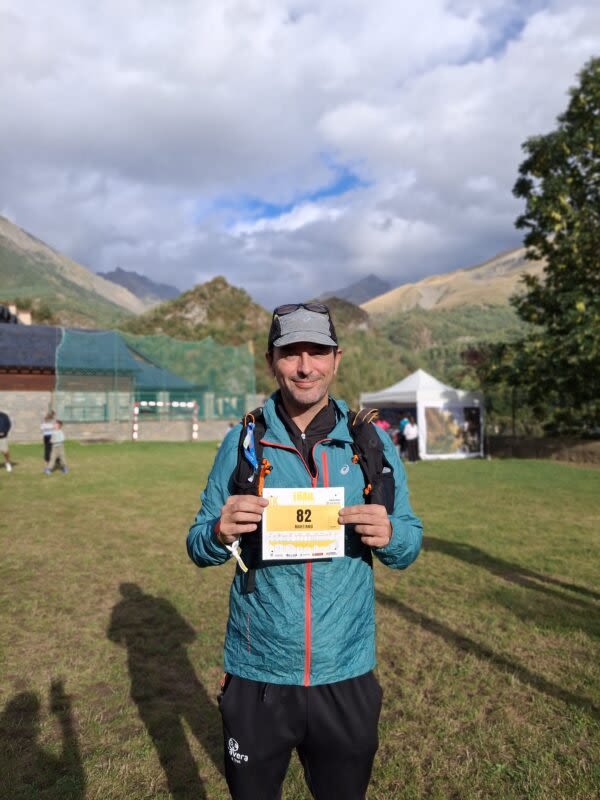
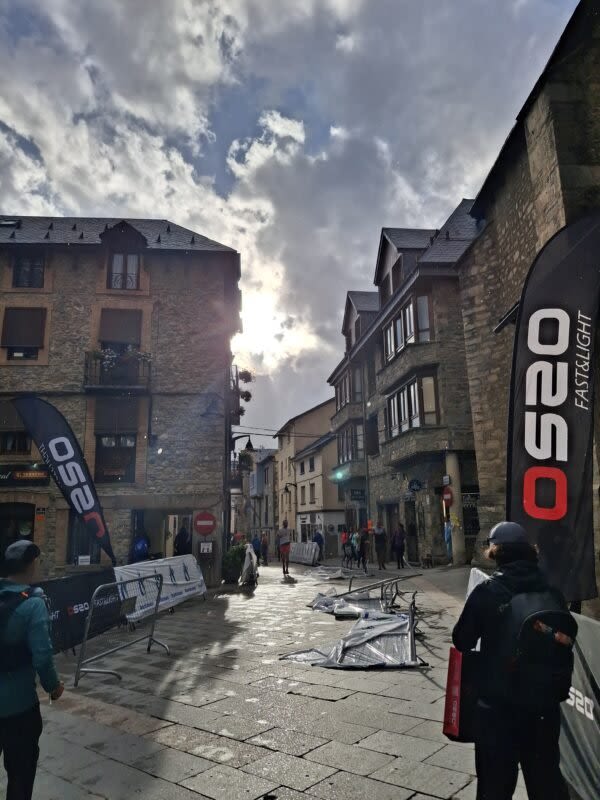
Bib collection was quick and well organised in an area next to the finish line. We were fitted with our GPS tracking devices, underwent an initial mandatory kit check and dropped off the two drop bags that would be available at designated points along the course. Another kit check would take place at the start.
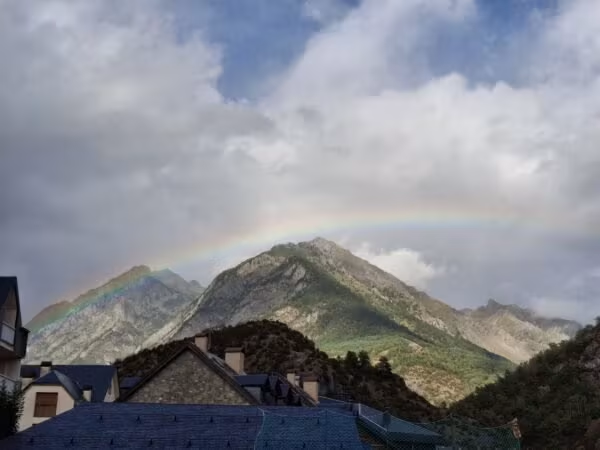
A light drizzle treated us to a beautiful rainbow during registration, a promising welcome to the mountains.
At 5:00 a.m., around 200 brave runners gathered at the starting line. The weather was cool but pleasant, setting the scene for what promised to be a spectacular day in the mountains.
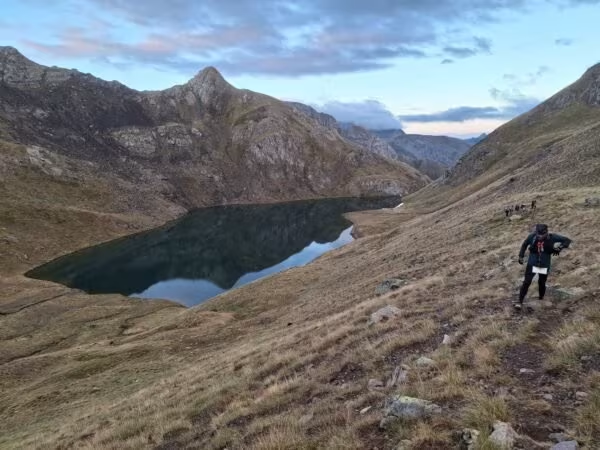
The opening 20 km involve an almost continuous climb, with approximately 2,500 metres of elevation gain before reaching Collao Perforao.
Along the way, there are a few short descents, including the section around Collado Catieras, but much of the route remains above 2,000 metres.
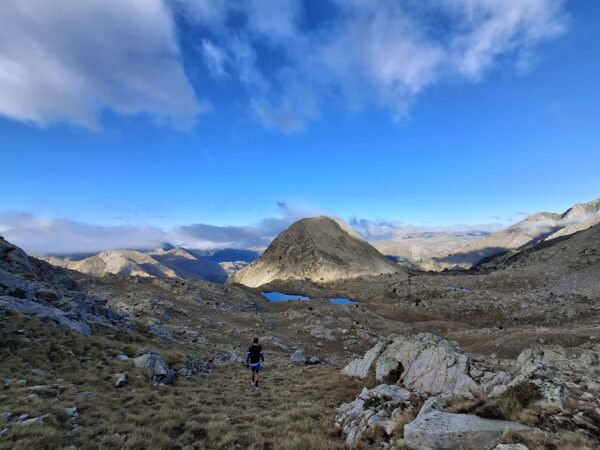
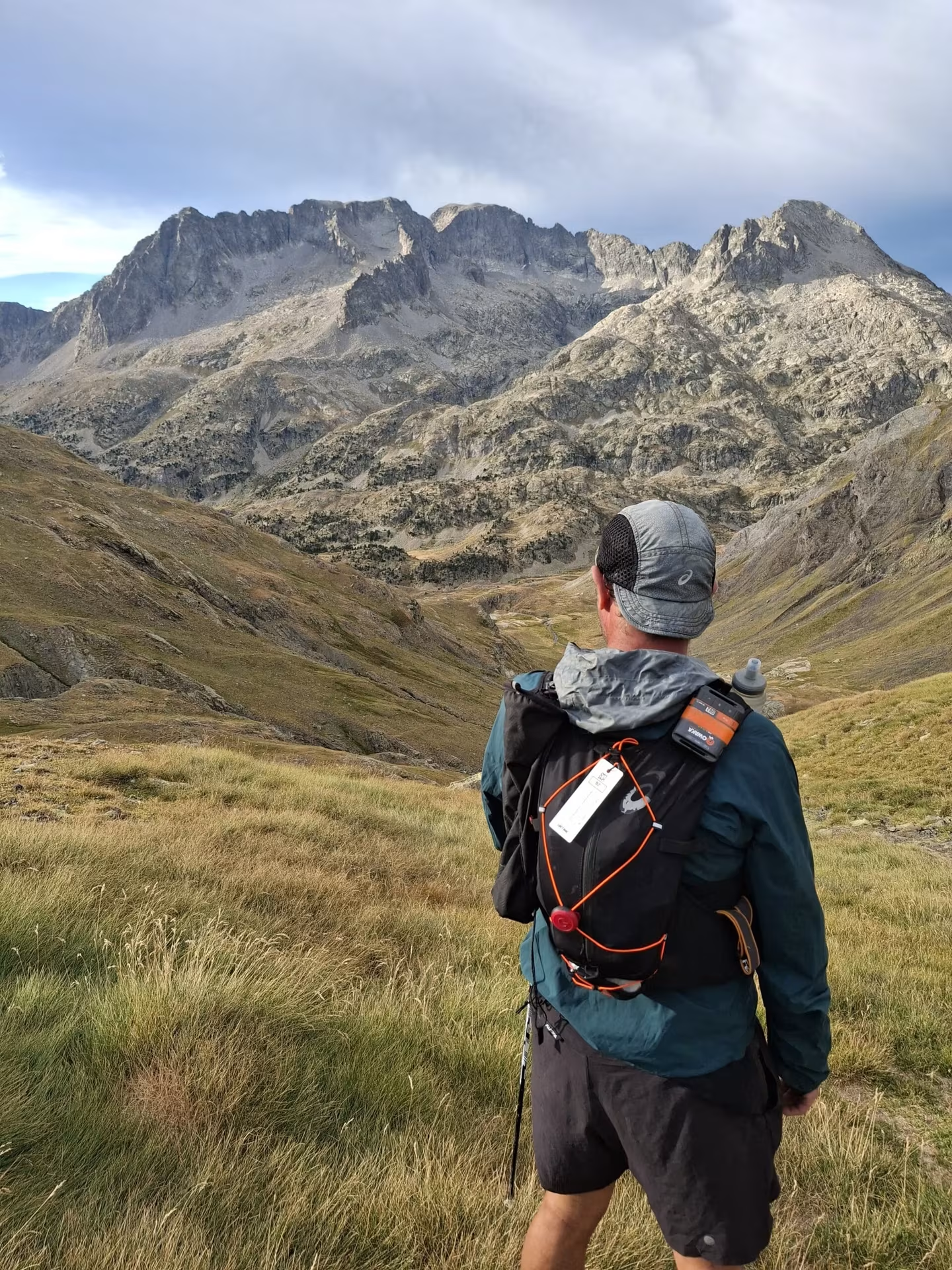
As dawn breaks, the landscape gradually reveals its full grandeur. Beautiful mountain lakes, known locally as ibones, appear along the route, surrounded by imposing peaks. There are moments when you simply have to stop and take in the view.
But the daylight reveals something else, too: just how technical and demanding the terrain will be for the many hours still ahead.
Reaching Collao Perforao marks the beginning of a long descent. The first part is highly technical, before the terrain becomes more runnable. Eventually, we descend around 1,000 metres to reach Casa de Piedra, where our first drop bag awaits.
It's time to change clothes, refuel and prepare for the next major challenge: climbing Garmo Negro, which rises to 3,051 metres.
The aid stations throughout the race are outstanding. They provide everything the organisers promised in the excellent race information booklet, and having hot food available at so many points is particularly welcome during an ultra of this length.
For the more ambitious runners, leaving Casa de Piedra also marks the start of a timed segment that finishes at the summit of Garmo Negro. Anyone completing it in under two hours earns a cap from technical sponsor OS2O.
Ahead lies a climb of roughly 1,400 metres of elevation gain. The temperature is rising, but the numerous waterfalls and streams along the way offer plenty of opportunities to cool down. Even at this time of year, the amount of water flowing through the mountains is remarkable.
It's a tough ascent, but visually fascinating. There are always new things to admire, and the number of people on the mountain makes the climb feel less solitary.
I'm particularly happy to see young people enjoying the mountains with their parents, far from cities and electronic devices. I find myself thinking that I would love to return here with my own children one day so they can experience this incredible landscape.
As we approach the summit ridge, a tape barrier marks the boundary that runners must not cross, as explained during the technical briefing. These briefings are worth listening to before any race, but in high-mountain events they are essential. Looking down to the left, I understand exactly why the restriction is there: the drop is not for anyone uncomfortable with heights.
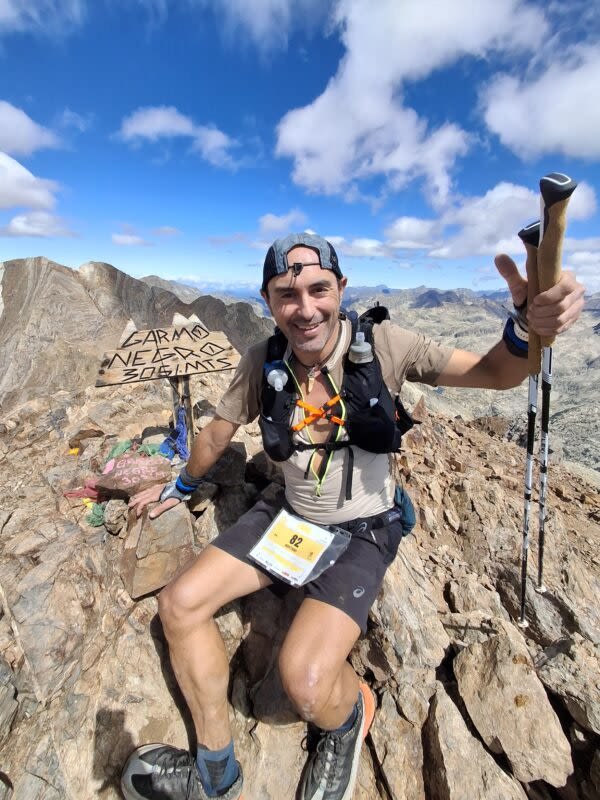
Reaching the summit of Garmo Negro is an unforgettable moment. It is my first 3,000-metre peak, and the feeling is difficult to put into words.
There are photos, a brief chat with the volunteers and a chance to appreciate the achievement. Then it's time to start descending towards Bachimaña Refuge.
Little do I know that this descent will become one of the longest-feeling sections of any race I have ever run.
The descent that tested my patience
The route from Garmo Negro to Bachimaña covers around 5 km, but the terrain is brutally technical. Huge rocks force us to pick our way down carefully, and at times our pace drops to around 25 minutes per kilometre.
After the effort of the climb, the descent is punishing on the legs. Mentally, it is just as demanding. The kilometres pass painfully slowly, and progress becomes a matter of fighting for every metre.
Bachimaña feels like an oasis in the desert.
A wonderful bowl of hot broth with rice and small pieces of ham brings me back to life. We refuel, refresh our minds and prepare for the next objective: Respomuso Refuge, around kilometre 44.
Before getting there, however, we must cross the Infiernos area and negotiate an initial technical descent equipped with ropes. The organisers have this section well controlled, with clear guidance on how to descend as safely as possible.
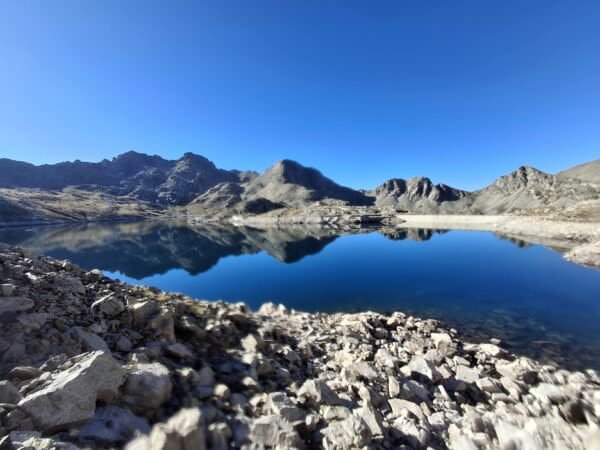
The route towards the refuge crosses beautiful meadows, passes more mountain lakes and follows crystal-clear streams. We even have to weave around a few flocks of sheep, which look at us with complete indifference as these strange humans jog past.
The arrival at Respomuso provides another unforgettable view. The sun is beginning to disappear, and its reflection on the reservoir creates a picture-perfect scene.
Moments like this remind me how fortunate we are to be able to take part in this sport.
We make a quick stop. We are still an hour ahead of the cut-off time, and I prefer not to spend too long at the aid station.
After crossing the dam, we begin another climb, this time towards Collado de Musales. As we gain altitude, the sun sinks lower and darkness begins to settle over the mountains.
And, without me fully realising it, darkness also begins to settle over my mind.
The final section towards the pass is difficult and involves ropes again, but the organisation and volunteers are once more excellent. The route is clearly marked, and we are guided through the trickier sections.
We reach the pass just in time to watch the sun disappear. Far below, at the bottom of the valley, we can see Sallent de Gállego, our next destination and the location of our second drop bag.
Ahead lies a 7 km descent, now entirely in darkness.
Metre by metre, my mind begins to enter dangerous territory. Without noticing exactly when it happens, I start to disconnect from the race. My thoughts become increasingly negative, and I gradually lose the determination that has carried me through the previous 17 hours.
When I finally reach Sallent, I tell the organisers that I am withdrawing. I hand back my race bib and GPS tracker, and my adventure comes to an end.
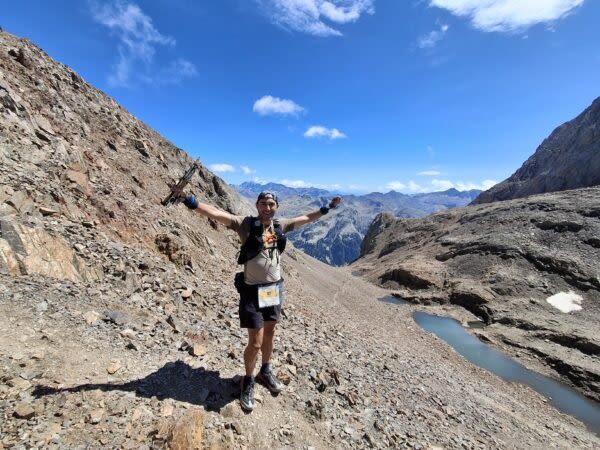
Looking back, I can recognise almost every mistake an ultrarunner can make in that situation.
I made my decision without giving myself time to think. I could have changed clothes, eaten something, spoken calmly with my wife and friends, and then decided whether to continue. Instead, I did everything in the wrong order.
I let the worst moment of the race make the decision for me.
It was a painful lesson, but one that has stayed with me and helped shape how I approach subsequent ultras.
After 17 hours of running, 57 km covered and approximately 5,400 metres of elevation gain, my mind had beaten me that day.
I don't tell this story to suggest that every withdrawal is a mistake. Sometimes stopping is absolutely the right decision, particularly when health or safety is at stake. But in my case, I learned how important it is to avoid making a definitive decision in the middle of a mental low without first taking a moment to recover, eat, talk and reassess the situation.
An ultra is not just a physical challenge. It is also a succession of decisions, and sometimes the most important one is to give yourself time before making the next move.
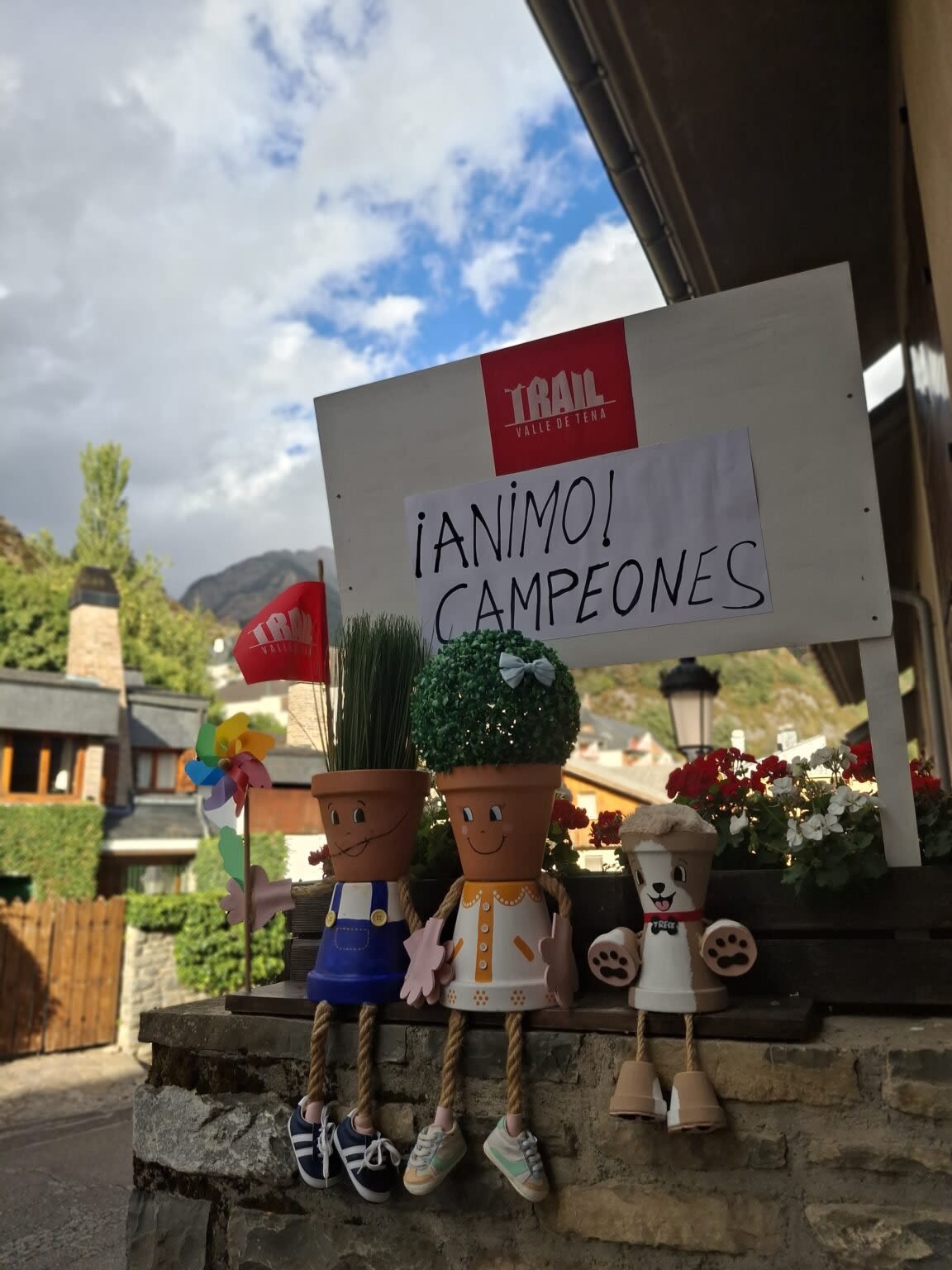
Although I didn't reach the finish line, I came away with a very positive impression of the event.
The course marking was excellent, and the organisers provided support at difficult and potentially dangerous sections. The aid stations were superb, and the volunteers were exceptional.
For me, one of the most important things in a mountain ultra is the feeling that you are supported and safe, even when the terrain becomes challenging. Throughout the race, the volunteers helped create exactly that feeling.
OS2O was the technical sponsor, and finishers received a technical vest and sweatshirt in addition to the T-shirt included in the race pack. They looked like fantastic rewards for those who completed the challenge.
One aspect that deserves particular recognition is the race's commitment to the environment.
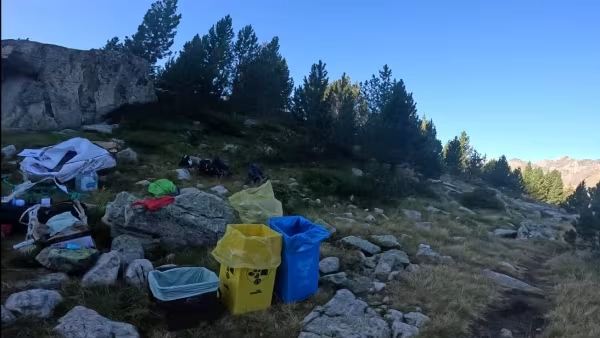
The organisers get top marks from me here. Every aid station had recycling bins, and the staff actively helped runners dispose of their waste correctly, politely pointing out which bin to use when necessary.
The runners also deserve credit. I didn't come across any discarded gel wrappers, bar wrappers or similar rubbish along the route.
In a high-mountain environment this beautiful, protecting the landscape should be part of the race experience, not an afterthought.
Another thoughtful detail is the organisers' communication in the months leading up to the event.
They send training sessions and recommendations to registered runners and encourage participation through monthly training challenges, with completed challenges earning entries into prize draws.
It is a great way to build a community around the race and help participants prepare for what lies ahead.
Absolutely, with one important qualification: this is not a race for everyone.
The combination of distance, elevation gain, altitude and technical terrain demands experience, preparation and respect. I would recommend tackling several significant mountain challenges before committing to the 8K.
But if you are ready for it, the reward is extraordinary.
The landscapes are breathtaking, the course is demanding, the aid stations are excellent, and the organisation makes you feel supported throughout the adventure. Panticosa and the surrounding valley also make a wonderful destination for anyone who wants to combine trail running with a few days in the mountains.
I didn't finish the Trail Valle de Tena 8K, but I left with a first 3,000-metre summit, unforgettable memories and a lesson that I will carry into future races.
I will be back, because this is a race I want to finish.
The mountains of Valle de Tena deserve it. And so does the runner I hope to become.
Login to your account to leave a comment.




Review gear you already use. Earn Star Points. Qualify to test free running shoes and gear.